

The Architecture of Desire: How Apple Uses the Psychology of Choice to Power a $1,000+ Average Selling Price

Executive Summary
Every September, social feeds fill with the same recurring skepticism: “It’s just last year’s phone with a new camera control and a fresh coat of titanium.” Commentators debate the slowdown of silicon breakthroughs, while consumers complain about four-figure price tags for incremental upgrades.
Then pre-orders open, and Apple logs another quarter of market-defying financials, pushing its global iPhone Average Selling Price (ASP) above $1,000.
This divergence between consumer skepticism and commercial dominance is deliberate:
- The Volume Ceiling Forces ASP Expansion: Global smartphone replacement cycles have stretched beyond 40 months. Because unit shipment growth has hit a structural wall, expanding net profit requires pulling the ASP lever.
- The Decoy Effect Drives the $100 Creep: Apple structures its tiering so the base model serves primarily as a psychological anchor, making intermediate and Pro models look like undeniable value upgrades for "just $100 more."
- Decoupled Friction via Mental Accounting: Lump-sum price resistance is neutralized through carrier trade-in equity and low-interest monthly installments, shifting four-figure hardware into routine operational expenses.
- The 76% Margin Trojan Horse: Hardware gross margins (~37%) exist to acquire users into the walled garden, where high-margin Services extract compounding digital rent for years.
1. The Volume Ceiling and the ASP Escalator
For the first decade of the modern smartphone era, enterprise growth was driven by greenfield market adoption. That era is closed. Replacement cycles across mature markets have expanded from 24 months to nearly 3.5 years.
Hardware Revenue = Unit Volume × Average Selling Price (ASP)
When unit volume stabilizes, top-line growth becomes an exercise in product mix optimization:
[ Saturated Unit Volume ] ──> [ Elongating Replacement Cycles (40+ Months) ]
                                            │
                                            ▼
[ The Strategic Mandate ] ──> [ Systemic ASP Escalation via Choice Architecture ]
                                            │
                                            ▼
[ Pro & Pro Max Dominance ] ──> [ Over 55% of Sales Mix Captured at >$1,000 ASP ]
By engineering a consumer migration from standard base tiers into the Pro and Pro Max segments, Apple shifted the majority of its sales mix into SKUs priced above four figures without triggering unit demand destruction.
2. The Decoy Effect & "The $100 Creep"
In classical economics, introducing an additional alternative should never increase the demand for an existing product. In behavioral finance, asymmetric dominance proves otherwise.
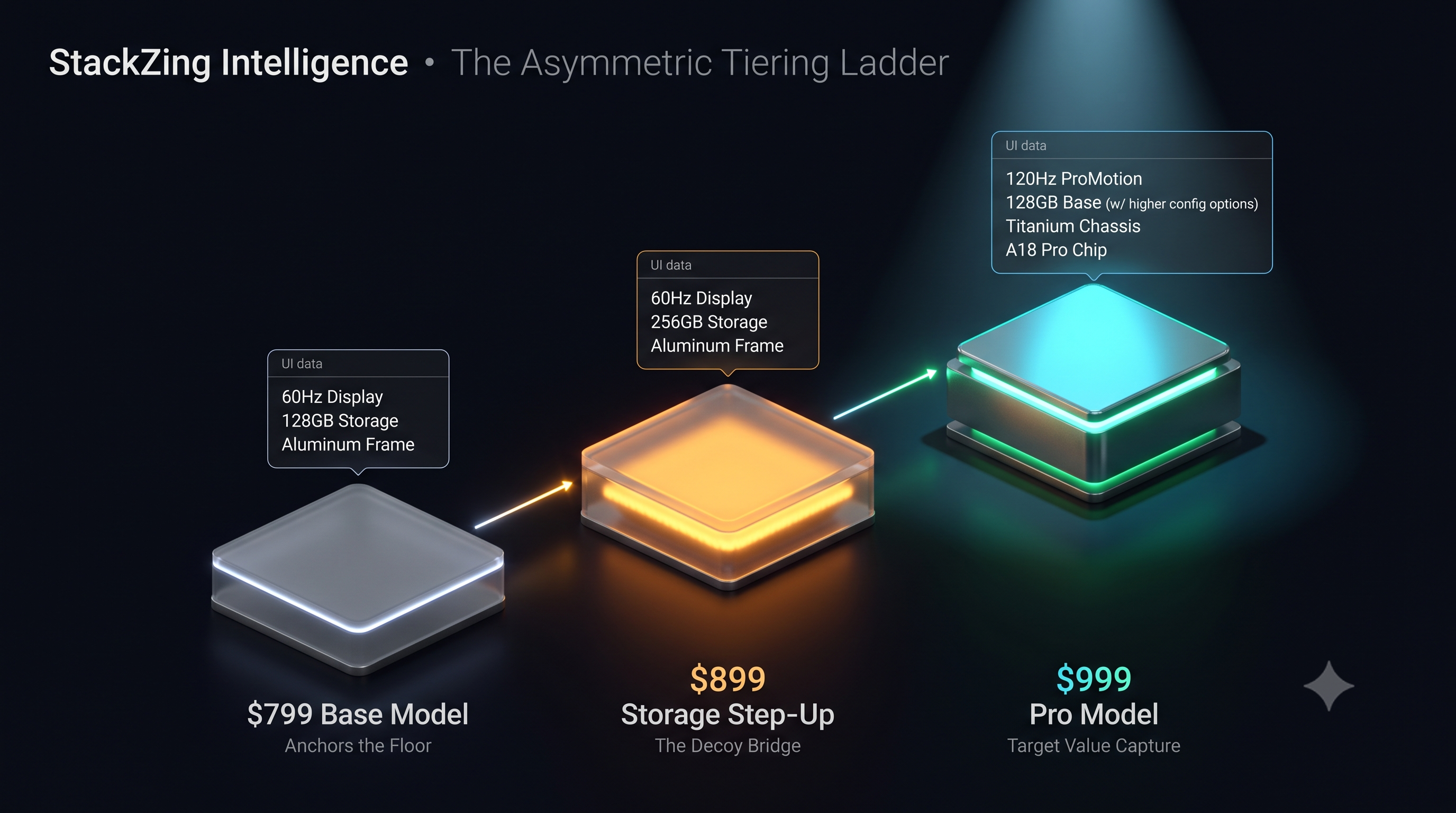
When a consumer evaluates options, the brain seeks shortcuts to assess value. Apple structures its product lineup to exploit the Decoy Effect:
┌─────────────────────────────────────────────────────────────────────────┐
│                      THE ASYMMETRIC TIERING LADDER                      │
└────────────────────────────────────┬────────────────────────────────────┘
                                     │
         ┌───────────────────────────┼───────────────────────────┐
         ▼                           ▼                           ▼
┌──────────────────┐       ┌──────────────────┐       ┌──────────────────┐
│    BASE MODEL    │       │  STORAGE STEP-UP │       │    PRO MODEL     │
│       $799       │ ────> │       $899       │ ────> │       $999       │
├──────────────────┤       ├──────────────────┤       ├──────────────────┤
│ • Entry Anchor   │       │ • Asymmetric     │       │ • 120Hz Display  │
│ • Standard Glass │       │   Decoy          │       │ • Telephoto Lens │
│ • 128GB Storage  │       │ • Double Storage │       │ • Titanium Build │
│ • 60Hz Display   │       │ • Still Base HW  │       │ • Best Silicon   │
└──────────────────┘       └──────────────────┘       └──────────────────┘
  [Anchors the Floor]        [The Decoy Bridge]        [Target Value Capture]
- The Anchor: The $799 base model establishes the initial spending baseline in the buyer's mind.
- The Decoy: Upgrading the base model's storage adds $100, bringing the price to $899.
- The Up-Tier Close: At $899, the customer is positioned just $100 away from the $999 Pro line. The marginal jump to get superior chassis materials, higher refresh rates, and professional-grade cameras suddenly feels like a sensible decision rather than an extravagance.
The middle configuration serves as a decoy bridge: it makes the leap from $799 to $999 feel like a minor incremental step rather than a 25% price increase.
3. Anchoring and the Compromise Effect (Extremeness Aversion)
Behavioral economists Amos Tversky and Daniel Kahneman established the principle of Extremeness Aversion: when confronted with multiple options, consumers systematically avoid the perceived extremes. The lowest-priced tier feels deficient; the highest-priced tier feels indulgent. Consequently, buying volume converges in the middle.
Apple shifts where that "middle" sits by extending the upper boundary:
- By offering ultra-premium 1TB Pro Max configurations priced at or above $1,599, Apple resets the category ceiling.
- Against a $1,600 anchor, a $1,099 Pro phone ceases to register as an extreme luxury.
- The consumer's cognitive shortcut reclassifies the four-figure purchase as the rational, balanced, middle-of-the-road choice.
By setting the outer limits of the product catalog, Apple dictates what feels reasonable.
4. Decoupling the "Pain of Paying"
Transaction friction is governed by Richard Thaler’s model of Mental Accounting. Handing over $1,200 in cash triggers immediate discomfort in the brain's prefrontal cortex. Apple removes this friction by uncoupling payment from immediate cash outflow:
[ $1,200 Upfront Lump Sum ]  ──>  [ Acute Pain of Paying / High Transaction Hesitation ]
                                                 │
                                                 ▼
[ Installments: $41.62/mo ]   ──>  [ Operational Cash Flow / Friction Disappears ]
                                                 │
                                                 ▼
[ Carrier Trade-in Credit ]   ──>  [ Loss Aversion Triggered: "Protect Depreciating Equity" ]
- The Installment Shift: Converting a $1,200 capital expense into a $41-per-month line item moves the transaction from a major budget decision to a minor monthly expense, alongside streaming subscriptions and utility bills.
- The Trade-in Endowment Reversal: By guaranteeing up to $400-$600 for an older device, Apple activates Loss Aversion. The consumer views skipping the upgrade not as saving $800, but as forfeiting hundreds of dollars in expiring trade-in value.
5. Sectoral & Financial Breakdown: Hardware vs. Services
Hardware purchases provide the entry point into Apple’s true financial engine: its Services ecosystem.
| Metric / Dimension | Products (iPhone, Mac, Wearables) | Services (iCloud, AppleCare, App Store) | Strategic Dynamic |
|---|---|---|---|
| Gross Margin Profile | 36.5% – 38.0% | 74.0% – 76.5% | Services generate more than double the margin efficiency |
| Revenue Nature | One-time, cyclical (every 36–42 months) | Recurring monthly/annual subscription | Predictable cash-flow compounding |
| Input Cost Exposure | Silicon yields, assembly labor, rare metals | Near-zero marginal distribution costs | Insulated from global supply-chain shocks |
| Ecosystem Attachment | High hardware lock-in (AirTags, Watch) | Multi-device data lock-in (iCloud backups) | High switching friction to alternative platforms |
[ Hardware Sale (Gross Margin: ~37%) ]
                   │
                   ▼  User Acquisition Gate
[ Active Base (>2.5 Billion Connected Devices) ]
                   │
                   ▼  Compounding Ecosystem Moat
[ Services Revenue (Gross Margin: ~76%) ]
                   │
                   ├──> iCloud Storage (Recurring Data Rent)
                   ├──> AppleCare+ (Upfront Risk Mitigation)
                   └──> App Store & Pay Take-Rates (Platform Fees)
Hardware sales fuel the active device footprint; the recurring Services business extracts cash from that installed base month after month.
6. The Strategic Playbook for Product Leaders
Business leaders can apply Apple's choice architecture principles to software, enterprise pricing, and consumer products:
- Audit the Decoy Placement: If customers gravitate toward the lowest-priced tier, your mid-tier option is likely competing with your premium tier instead of channeling users toward it. Rebalance intermediate pricing to make the top-tier jump look logical.
- Anchor the Upper Extreme: Introduce a high-spec flagship tier, even if unit volume for that SKU remains modest. Its primary function is to expand the frame and make the intermediate options appear accessible.
- Decouple Lump-Sum Pricing: Reframe major transactional outlays into predictable monthly schedules, usage-based increments, or trade-in trade-offs to lower purchase hesitation.
- Design the Ecosystem Flywheel: Treat the core product purchase as customer acquisition. Map out the high-margin services, data infrastructure, or recurring integrations that will monetize the customer over their entire lifetime.
The Strategic Verdict
Apple's launch cycles illustrate that sustainable pricing power is rarely built on feature lists alone. By mastering choice architecture, framing, and payment psychology, Cupertino has built an engine that consistently drives customers toward premium tiers.
Consumers do not pay four figures for consumer electronics simply because of marginal silicon upgrades. They pay because the options are arranged so that choosing the premium tier feels like the only rational decision.