

Is Agentforce Dead? The Claudeforce Shift: Inside Salesforce and Anthropic’s Alliance to Build the First "Headless CRM"
Why Salesforce is embedding its entire system of record inside Claude, turning Agentforce into an open reasoning runtime, and quietly ending the 25-year era of manual browser-based data entry.
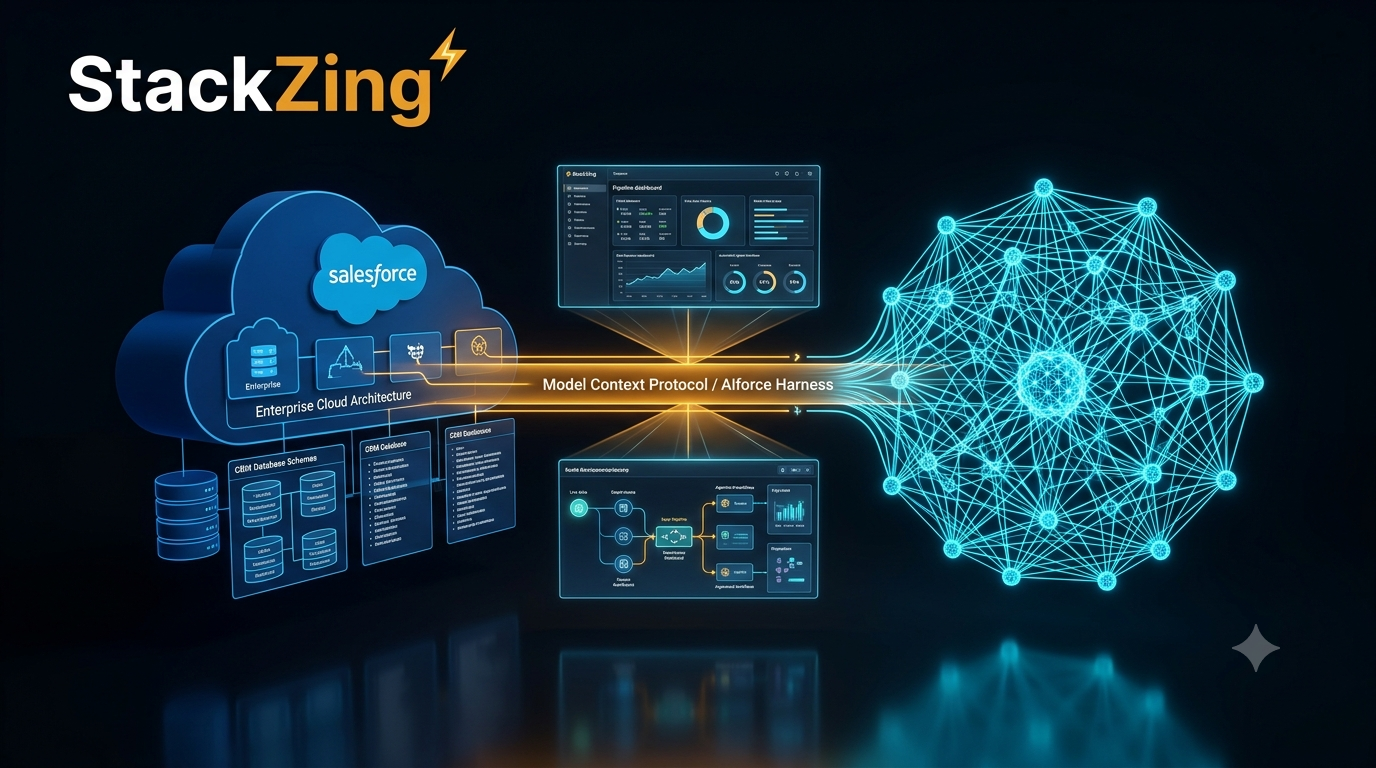
When Salesforce and Anthropic unveiled Claudeforce, the initial reaction from industry commentators was swift: Did Salesforce quietly admit defeat on Agentforce? Did they give up on in-house frontier AI models? The short answer is no. Salesforce executed the most calculated architectural pivot in enterprise SaaS history. By embedding its entire System of Record natively inside Anthropic’s Claude via the Model Context Protocol (MCP) and integrating Claude as the default reasoning brain for the Atlas Reasoning Engine, Salesforce solved the fundamental paradox of enterprise AI: Probabilistic frontier intelligence cannot govern enterprise compliance, and deterministic CRMs cannot reason. This report provides the definitive architectural breakdown of the Claudeforce integration, the rise of the "Headless CRM," and the strategic blueprint for enterprise CIOs.
1. The Death of the Browser Tab: Why 25 Years of SaaS UI Failed
Since Marc Benioff launched Salesforce in 1999 under the banner of "No Software," the enterprise technology universe has operated under a single, unchallenged operational paradigm: the human knowledge worker must open a web browser tab and manually input data into structured database fields.
For a quarter of a century, software vendors added complexity on top of this model. Opportunities were linked to Contacts; Contacts were mapped to Accounts; Accounts were tied to Custom Objects, Validation Rules, and Approval Flows. By 2024, the modern enterprise revenue tech stack had metastasized into an administrative nightmare:
- The 70/30 Selling Inversion: Industry benchmarks reveal that modern enterprise account executives spend less than 30% of their working hours actively engaging prospects. The remaining 70% is consumed by data entry, pipeline hygiene, call note transcription, and screen flow navigation.
- Context Fragmentation & UI Fatigue: Updating a single enterprise renewal often requires navigating through 8 to 15 discrete browser tabs across Salesforce, Gong, Slack, DocuSign, and Google Workspace.
- Data Hygiene Decay: Because manual data entry is slow and tedious, enterprise CRM databases suffer from chronic data rot. Sales reps log the absolute minimum required data, rendering executive forecasting dashboards inaccurate.
Meanwhile, employees began adopting standalone frontier AI models—most notably Anthropic’s Claude. But early chatbot adoption created a dangerous fracture: the intelligence lived in the chat window, while the verified business reality remained locked inside Salesforce. An AI assistant that cannot read your live sharing rules or write back to your system of record is nothing more than a conversational toy.
Claudeforce resolves this fracture by making the CRM headless.
2. Did Agentforce Fail? The Strategic Reality
To understand why Salesforce partnered so aggressively with Anthropic, one must dismantle the false narrative that "Agentforce failed."
Skeptics assumed that when Salesforce announced Agentforce in late 2024, it was attempting to compete head-on with OpenAI, Anthropic, and Google DeepMind in training multi-trillion-parameter foundational language models. This was a profound misunderstanding of enterprise computing layers.
Building frontier LLMs from scratch requires tens of billions of dollars in annual capital expenditures on GPU clusters, and raw model weights face rapid commoditization cycles. Salesforce recognized that its competitive advantage was never going to be out-training Anthropic or Google on raw benchmark logic.
Instead, Salesforce’s unassailable moat is its enterprise metadata graph. By integrating Claude into Agentforce’s Atlas Engine, Salesforce transformed its platform from a software UI into the enterprise operating system that makes frontier intelligence governed, secure, and actionable.
3. Inside the Claudeforce Architecture: The Symmetrical Fusion
Claudeforce is not a superficial API integration. It is a deeply co-engineered, bi-directional enterprise architecture that operates across two primary pipelines:
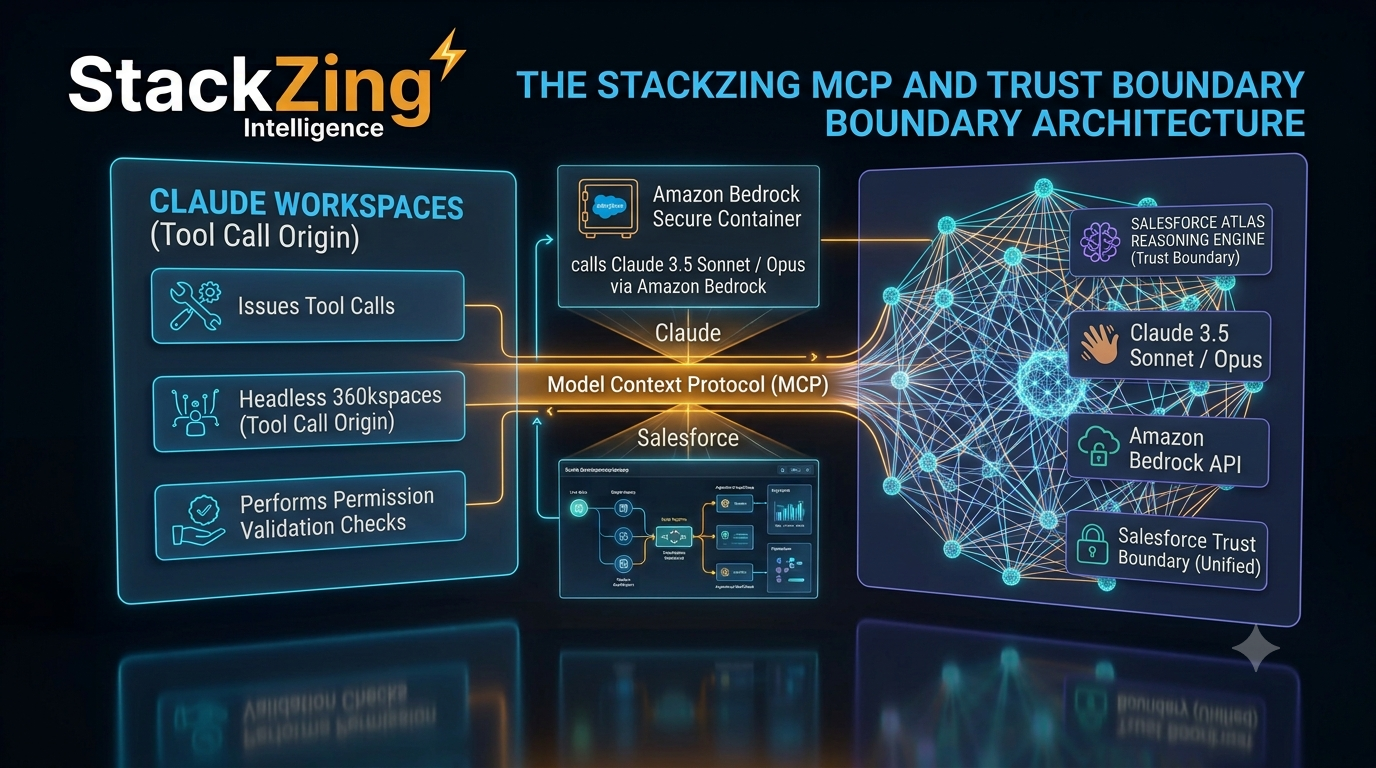
Pillar A: Salesforce Inside Claude (The Headless Interface)
Powered by Salesforce’s new AIforce harness and the open-source Model Context Protocol (MCP), Claude can now act as a full-fledged enterprise client. When a sales professional opens their Claude desktop or web interface:
- 37 Pre-Built Domain Skills: The integration ships out-of-the-box with specialized enterprise workflows, including Real-Time Pipeline Health Diagnostics, Account Opportunity Mapping, Automated Deal Win/Loss Analysis, and Multi-Participant Executive Briefing Synthesis.
- Zero-Copy Context Assembly: Claude dynamically queries Salesforce Data Cloud and CRM records using OAuth 2.0 on-behalf-of authorization, assembling relevant customer history without requiring data replication or manual copy-pasting.
- Inherited Role Hierarchy & FLS: Every action Claude takes strictly inherits the user’s exact Field-Level Security (FLS), Sharing Rules, and Record-Level Permissions. If a sales rep is barred from viewing margin percentages or executive compensation in Salesforce, Claude cannot view or synthesize that data.
Pillar B: Claude Inside Agentforce & Slack (The Reasoning Engine)
Simultaneously, Anthropic’s frontier models have been embedded directly into Salesforce’s core runtime:
- The Atlas Reasoning Engine Backbone: When developers configure autonomous agents in Agent Builder, Claude serves as the primary reasoning brain behind the Atlas Engine, evaluating complex user intents, generating multi-step plans, and selecting appropriate tool actions.
- The Salesforce Trust Boundary via Bedrock: Enterprise requests to Claude are routed securely through Amazon Bedrock within the Salesforce Trust Boundary. Customer data is zero-retained by Anthropic and is never used to train foundational public models.
- Native Slack Intelligence: Claude becomes the default intelligence engine across the Slack ecosystem, powering Slackbot summaries, channel search, `@Claude` collaborative reasoning, and automated code generation via Slack Code.
4. Benioff’s Law: Probabilistic Reasoning vs. Deterministic Governance
Marc Benioff articulated the core philosophical thesis underlying Claudeforce in a single definitive statement:
"Probabilistic intelligence alone doesn’t run a company, and deterministic systems don’t reason. By fusing Claude’s extraordinary reasoning with the trusted data, workflows, and governance every enterprise runs on, we’re delivering a dynamic interface that thinks, reasons, and acts."
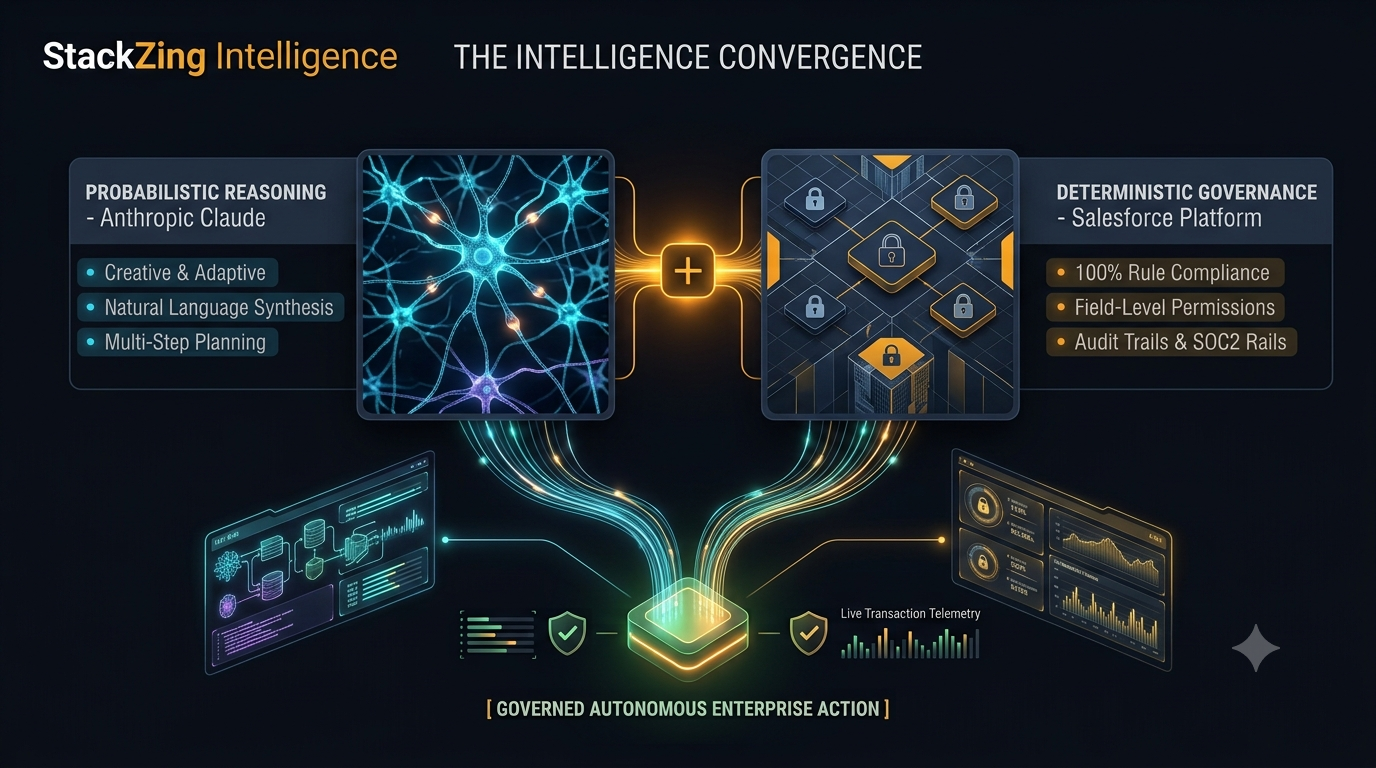
This dichotomy represents the fundamental challenge of enterprise autonomy. Consider what happens when an enterprise relies solely on one side of this equation:
- The Failure Mode of Pure LLMs: Large language models are probabilistic token predictors. When given unfettered write access to a database, they will eventually hallucinate non-existent discount approvals, bypass required credit checks, violate regional data sovereignty rules (GDPR/CCPA), or execute conflicting database commits.
- The Failure Mode of Pure CRMs: Traditional deterministic databases are rigid state machines. They cannot read 40 unorganized email threads, extract implicit buyer objections, synthesize sentiment shifts across an executive buying committee, or formulate a customized renegotiation strategy.
2. Plan Generated → [Tool: "UpdateOpportunityStage", Target: "Stage 4 - Negotiation"]
3. MCP Verification Gateway → Intercepts Tool Call via AIforce Harness
4. Salesforce Policy Enforcement Engine:
• Check User Auth & Role Hierarchy (FLS Validated ✓)
• Execute Validation Rule: [Mandatory Security Review Document Attached? ✓]
• Trigger Apex Audit Trail & Data Cloud Zero-Copy Sync ✓
5. Deterministic Commit → Database Updated → Claude Receives Verified Output Payload
Master Enterprise AI Architecture, SaaS & Cloud Infrastructure
Join 5,000+ CIOs, enterprise architects, and technology founders receiving our free 5-minute daily intelligence brief. Zero fluff. Pure signal.
Subscribe Free at thestackzing.com →5. The 4-Step Strategic Playbook for CIOs, Architects & RevOps
For technology executives and enterprise architects managing Salesforce orgs, Claudeforce requires an immediate shift in tooling, governance, and developer resource allocation:
The Strategic Verdict: The Era of Headless SaaS Has Begun
The Claudeforce alliance is not the story of a software incumbent surrendering to an AI startup. It is the story of an enterprise titan recognizing that in the age of agentic intelligence, the interface is no longer the moat.
By unbundling its database and workflows from the legacy web browser, Salesforce has positioned itself as the indispensable foundation for autonomous business execution. Enterprise value is no longer measured by how many minutes employees spend clicking inside a CRM dashboard—it is measured by the speed and governance with which an organization can transform raw business context into verified action.
Stay Ahead of the Enterprise AI & Cloud Revolution
Join thousands of enterprise executives, cloud architects, and founders who read the StackZing Intelligence Morning Brief. Daily 5-minute data-driven breakdowns delivered straight to your inbox.