
The End of the Touchscreen: How Meta’s TRIBE v2 Turns Human Muscle Twitches into Pure AI Compute
Inside Meta’s whole-brain foundation model—and why decoding neuromuscular telemetry milliseconds before your fingers move is the definitive operating system for post-smartphone computing.
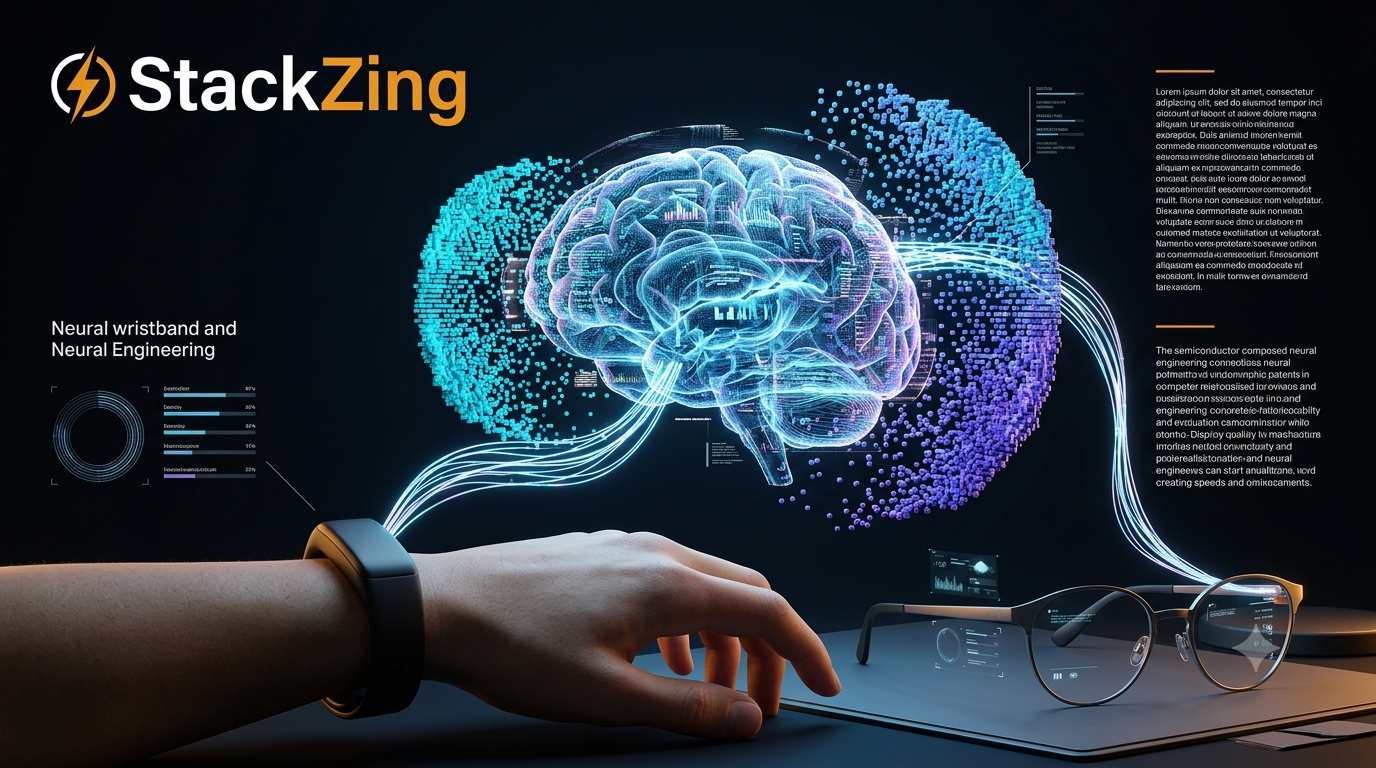
While the artificial intelligence race remains hyper-focused on conversational chatbots and generative video diffusion, Meta’s Fundamental AI Research (FAIR) team has been quietly solving a far more consequential problem: The Human-Machine Interface Bottleneck. Enter TRIBE v2. Trained across 1,115+ hours of multi-modal brain telemetry and continuous peripheral biosignals across 720+ human volunteers, TRIBE v2 replaces heuristic computer vision with a 75% masked spatio-temporal transformer capable of predicting 70,000 cortical functional MRI voxels in real time. By decoding surface electromyography (sEMG) at the wrist tens of milliseconds before tendons physically move, TRIBE v2 establishes the neural translation layer powering Meta’s Orion AR Glasses and neural wristbands—rendering touchscreens, physical keyboards, and optical hand tracking obsolete.
1. The Screen in Your Pocket Is About to Become Obsolete
For more than two decades, personal computing has been held hostage by a single mechanical bottleneck: tapping glass with our thumbs.
Every text message, software commit, database query, and interface navigation requires translating high-dimensional human thought into mechanical finger impacts at a glacial rate of roughly 40 words per minute. While Large Language Models have scaled computational intelligence exponentially, the physical interface through which humans command that intelligence remains locked in the smartphone paradigm established in 2007.
Attempts to break free from the touchscreen have repeatedly stalled against insurmountable physical and social barriers:
- Voice Assistants Are Socially Non-Viable: Speaking aloud to an AI assistant is impossible in open-plan offices, public transit, executive meetings, or crowded coffee shops.
- Optical Hand-Tracking Fails Under Occlusion: Camera-based spatial tracking (such as Apple Vision Pro) collapses the exact millisecond your hands drop below a desk, rest on your lap, or slip inside a jacket pocket. Furthermore, holding one's arms extended in mid-air induces rapid musculoskeletal fatigue ("Gorilla Arm Syndrome").
- Invasive Brain Implants Face High Risk Profiles: Direct cortical interfaces (such as Neuralink) offer high bandwidth but require surgical craniotomies and medical supervision, limiting their reach to clinical neuro-prosthetics rather than broad consumer adoption.
Meta’s solution is not another conversational chatbot or a bulkier VR headset. It is TRIBE v2—a foundation model architecture designed to decode human motor and cognitive intent directly from the peripheral nervous system with non-invasive, sub-millimeter precision.
2. The Physics of Intent: Decoding Neuromuscular Action Potentials
To understand why TRIBE v2 represents an architectural turning point, one must examine the electromechanical sequence that occurs every time a human interacts with a computing device:
│ (Action Potential travels down spinal column)
▼
[ 2. Motor Neurons Fire Down Forearm ]
│ (Microvolt Electrical Waves at Wrist Skin Surface: sEMG)
▼
[ 3. Forearm Tendons Contract & Fingers Move ] → 50ms – 100ms Latency Delta
│
▼
[ 4. Physical Impact on Keyboard / Glass Screen ]
When you decide to pinch your index finger and thumb, your central nervous system fires electrical action potentials down the radial and median nerves into your forearm. These microvolt electrical signals ripple across the surface of the skin 50 to 100 milliseconds before your tendons physically contract and your fingers move.
Historically, decoding surface electromyography (sEMG) at consumer scale was considered an intractable engineering problem. Every human possesses a unique musculoskeletal geometry, skin impedance fluctuates with sweat, and muscle fatigue rapidly distorts signal waveforms. Traditional machine learning algorithms required each user to spend 30 to 45 minutes performing repetitive calibration routines in a laboratory environment before a wearable could recognize a single gesture reliably.
TRIBE v2 eliminates per-user calibration through self-supervised foundation modeling.
Just as frontier LLMs learn the latent grammar of language by predicting missing tokens across billions of web pages, TRIBE v2 was pre-trained on massive streams of continuous neuromuscular and neural telemetry with 75% of the spatio-temporal data deliberately masked out. By forcing the transformer core to reconstruct the missing signals across time, the model internalized the universal kinematic physics of the human nervous system.
3. Inside the TRIBE v2 Architecture: The Tri-Modal Brain Twin
Rather than treating biological data as isolated, unimodal streams, TRIBE v2 represents an end-to-end multi-modal architecture that unifies visual perception, linguistic comprehension, auditory signals, and whole-brain cortical telemetry.
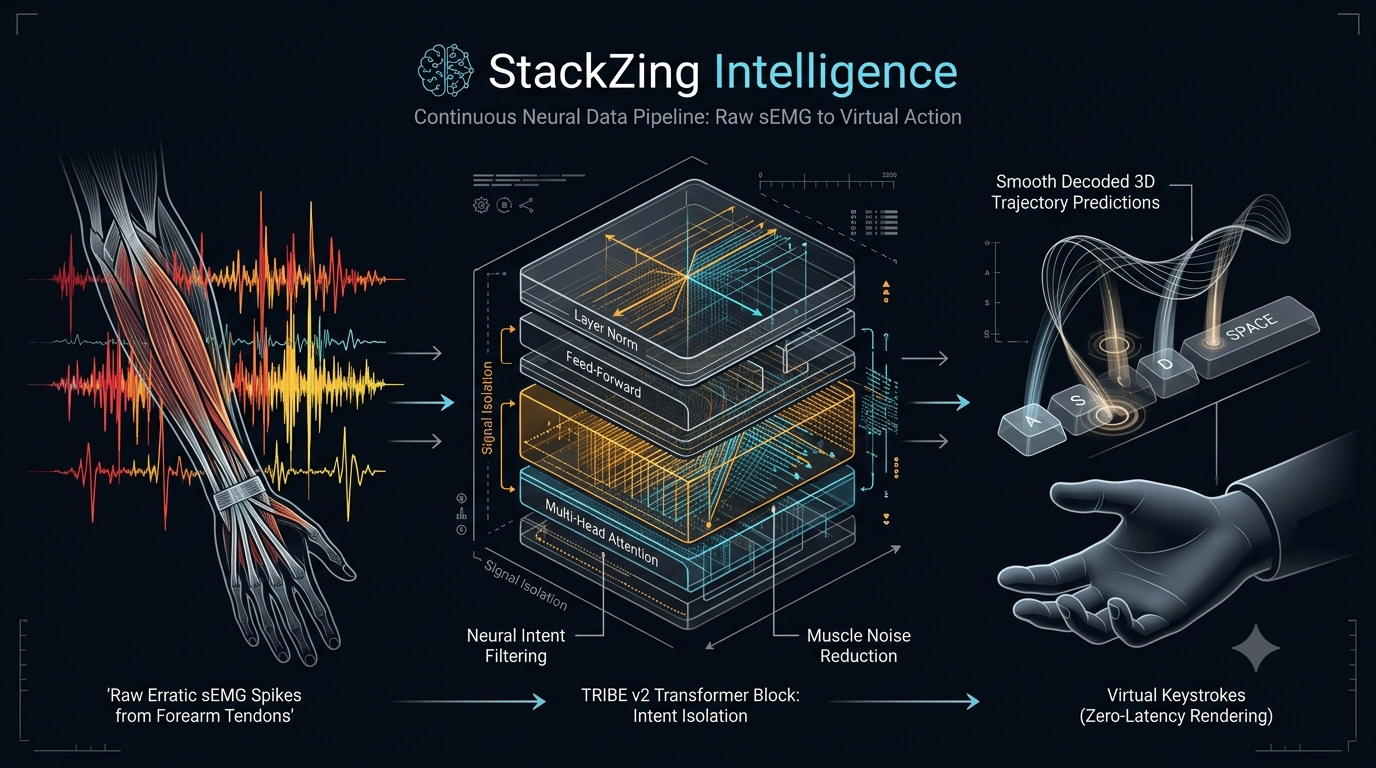
The Tri-Modal Ingestion & Disentanglement Engine:
4. Generational Leap: TRIBE v1 vs. TRIBE v2
The leap from Meta’s initial research prototype (TRIBE v1) to the foundational TRIBE v2 architecture represents a 70x increase in spatial resolution alongside complete zero-shot generalization:
Master Enterprise AI, Spatial Hardware & Foundation Models
Join 5,000+ technology leaders, chip architects, and founders receiving our free 5-minute morning intelligence brief. Zero fluff. Direct data.
Subscribe Free at thestackzing.com →5. The Hardware Endgame: Orion AR Glasses + The Neural Wristband
Why is Meta investing billions into behavioral foundation models while competitor labs remain focused purely on chatbot benchmark leaderboards?
Because TRIBE v2 represents the foundational operating system for the post-smartphone consumer hardware ecosystem:

The Two Pillars of Meta’s Post-Mobile Stack:
- The Display Layer (Orion AR Holographic Glasses): Thin, lightweight glasses equipped with custom silicon and diffractive waveguides that project interactive application windows, code environments, and telepresence feeds directly onto the physical environment without blocking eye contact.
- The Input Layer (Neural sEMG Wristband): A comfortable wristband equipped with integrated micro-electrodes that sample electromyographic signals at thousands of hertz, capturing motor neuron impulses before fingers move.
With a quantized TRIBE v2 model executing locally on an ultra-low-power Neural Processing Unit (NPU) embedded directly within the wristband, users can rest their hands naturally on their lap during an executive meeting, twitch their fingers by single-digit millimeters on an invisible surface, and achieve 120 words per minute silent virtual typing with zero visible physical movement and sub-8ms latency.
6. The In-Silico Neuroscience Revolution
Beyond consumer hardware controllers, TRIBE v2 introduces a structural revolution to clinical neuroscience and brain research:
Historically, conducting neuroimaging studies required scheduling human volunteers in multi-million-dollar functional MRI (fMRI) scanners, which cost upwards of $1,000 per hour and generate severe acoustic and physical discomfort.
Because TRIBE v2 acts as an accurate digital twin of the human sensory cortex, researchers can feed complex visual stimuli, auditory speech patterns, or natural language prompts directly into the model’s API and generate whole-brain voxel activation predictions in milliseconds on a single GPU. TRIBE v2 effectively transforms clinical neuroscience from an expensive physical laboratory procedure into scalable software simulation.
7. The New Data Moat: Continuous Biological Telemetry
The broader technology industry is discovering that while public internet text is running out, continuous biological and kinematic telemetry is an almost infinite data frontier:
- Web Scrapes Are Saturated: Training foundational models on recycled online articles faces severe synthetic data contamination, copyright litigation, and diminishing returns.
- Neuromuscular Telemetry Is Proprietary: Every hour a consumer wears an sEMG-equipped smartwatch or fitness band, millions of continuous datapoints covering motor velocity, nervous tension, fatigue curves, and reaction latencies are generated.
- Humanoid Robotics Synergy: The kinematic representations and latent motor dynamics learned by TRIBE v2 for human motion decoding transfer directly to the motor control architectures of humanoid robotics and robotic manipulation arms.
The Strategic Verdict
While the tech industry remains fixated on training chatbots to generate conversational text, the real battle for the post-mobile computing era is taking place in the milliseconds between human thought and physical action. By transforming whole-brain neuroscience from an expensive physical laboratory procedure into scalable in-silico computation, Meta’s TRIBE v2 demonstrates that the next computing paradigm will not be defined by teaching humans how to use machines—but by building machines smart enough to decode humans seamlessly.
Master Enterprise Tech, AI Architecture & Spatial Silicon
Join thousands of technology executives, chip architects, and founders who read the StackZing Morning Intelligence Brief. Daily 5-minute data-driven breakdowns delivered straight to your inbox.