
The Great Book Guillotine: Inside Anthropic's "Project Panama" and the Legal Frontier of AI Training
How unsealed federal court records exposed an industrial operation to slice, scan, and destroy millions of physical books—and why Judge Alsup’s fair-use ruling sets a precedent for generative AI compute.
 Prompt: A high-contrast, cinematic editorial hero graphic in 16:9 widescreen format. Top-left corner displays the "StackZing" logo in crisp white and warm amber (#F59E0B) with an electric spark emblem. The central visual contrasts two worlds: on the left, a traditional library of vintage physical hardcovers passing under an industrial laser-guided guillotine blade; on the right, the severed pages dissolving into glowing cyan (#38BDF8) digital tokens, binary code streams, and an illuminated neural network brain. Dark obsidian theme (#0B0F17), Swiss editorial aesthetic, 8k render.
The rapid evolution of frontier Large Language Models (LLMs) has collided with an existential barrier: the depletion of high-signal, human-authored text. As public web scrapes become contaminated by synthetic, machine-generated content, pre-2022 physical books represent the gold standard of coherent logic, multi-step reasoning, and intellectual depth. Unsealed court documents in Bartz v. Anthropic PBC revealed that Anthropic executed Project Panama—an operation to purchase millions of physical books from secondary liquidators, slice off their spines using hydraulic guillotines, scan them at high velocity, and discard the physical paper to train its Claude models. In a landmark opinion, Senior U.S. District Judge William Alsup ruled that while mass digital piracy remains unlawful, purchasing physical books and destructively digitizing them solely to extract statistical language patterns constitutes Transformative Fair Use protected by the First-Sale Doctrine.
1. The Synthetic Collapse Wall: Why AI Needs "Pre-AI" Human Thought
The public discourse surrounding artificial intelligence is dominated by hardware benchmarks: GPU cluster topology, High-Bandwidth Memory (HBM3e/HBM4) throughput, and model parameter counts. Yet, state-of-the-art transformer models remain fundamentally bounded by the informational entropy of their training datasets.
For the past decade, AI developers relied on massive web-scale corpora like Common Crawl, extracting trillions of tokens from public websites, online forums, and digital news portals. However, this strategy has reached a point of severe structural exhaustion:
- The Synthetic Dilution Problem: A significant portion of newly published web content is now generated, summarized, or paraphrased by automated AI pipelines. Training newer models on recursive synthetic outputs induces Model Autophagy Disorder (MAD)—often termed "Model Collapse"—where models gradually lose linguistic diversity, tail-distribution knowledge, and long-range logical coherence.
- The Structural Superiority of Books: Published non-fiction, academic literature, and literature authored before 2022 contain edited, coherent, multi-thousand-word conceptual progressions. Books teach an AI model how to sustain complex context across tens of thousands of tokens—a capability essential for advanced coding, legal synthesis, and enterprise workflow execution.
- The Commercial Rights Impasse: While web scraping was initially treated as open data, book publishers and authors quickly organized into legal coalitions, demanding steep per-token licensing fees and filing sweeping copyright class actions against frontier labs.
Confronted with the choice between using degraded synthetic web data or paying billions in recurring licensing fees, frontier AI developers faced an architectural bottleneck. Anthropic’s solution was to bypass the digital licensing ecosystem entirely by turning to the physical secondary book trade.
2. The Mechanics of "Project Panama": Industrial-Scale Book Destruction
Internal memorandums unsealed during federal litigation detailed an aggressive, covert operation designated "Project Panama." The initiative was summarized internally by Anthropic personnel as a comprehensive campaign to "destructively scan all the books in the world" while keeping the workflow confidential to avoid early public pushback and vendor boycotts.
The 4-Stage Destructive Scanning Pipeline:
 Prompt: A technical 2D vector schematic infographic in 16:9 widescreen format on a deep obsidian background (#0B0F17). Header displays the watermark "StackZing Intelligence" with an amber electric badge (#F59E0B). The diagram maps the 4-phase transformation: 1) Palletized Physical Books; 2) Hydraulic Guillotine Slicing the Spine; 3) Automated Sheet-Fed Scanner converting paper to binary streams; 4) Text being tokenized into multi-dimensional neural tensor matrices while paper is shredded. Clean neon-cyan lines, amber accents, Swiss typographic precision.
3. The Judicial Crucible: Judge Alsup’s Fair Use Line in Bartz v. Anthropic
The revelation of Project Panama occurred during the class-action copyright lawsuit Bartz v. Anthropic PBC, presided over by Senior U.S. District Judge William Alsup in the Northern District of California.
The lawsuit consolidated claims by prominent authors who alleged that Anthropic had infringed their exclusive reproduction rights under 17 U.S.C. § 106 by ingesting copyrighted literary works into its training pipelines.
Judge Alsup’s landmark analysis established an essential legal distinction that now serves as a guiding precedent across the generative AI sector:
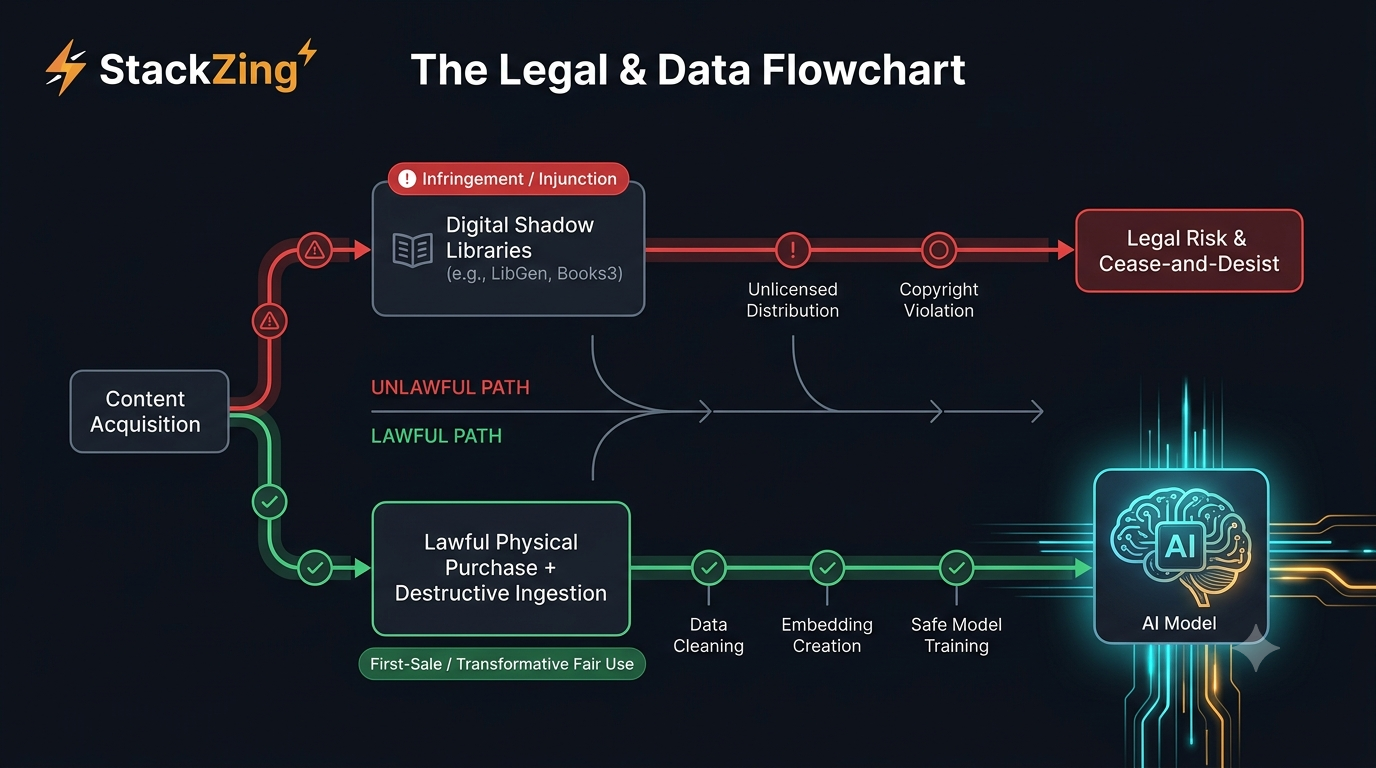
Pathway 1: Digital Shadow Libraries (Unlawful Piracy)
Anthropic, like several other early AI research labs, previously accessed and downloaded datasets from illicit digital repositories such as Books3 and LibGen. Judge Alsup firmly rejected fair-use defenses for this conduct, holding that downloading unauthorized pirated digital files directly bypasses authorized commercial channels, actively harms the primary market for copyrighted books, and constitutes statutory copyright infringement.
Pathway 2: Lawful Physical Purchase + Destructive Ingestion (Transformative Fair Use)
Conversely, the court held that purchasing legitimate physical copies on the secondary market and digitizing them for internal machine learning is protected under Transformative Fair Use (17 U.S.C. § 107) when paired with the First-Sale Doctrine (17 U.S.C. § 109).
The Two Legal Pillars Supporting the Ruling:
- The First-Sale Doctrine Exhaustion: Under 17 U.S.C. § 109, once a physical book is legitimately sold, the copyright owner’s right to control the distribution of that specific physical artifact is exhausted. The purchaser is legally entitled to lend the book, re-sell it, annotate it, or physically shred it. Converting the book into an intermediate digital format to facilitate analysis—without re-selling the digital copy—was ruled an extension of this lawful possession.
- The Extraction of Uncopyrightable Statistical Concepts: U.S. copyright law protects the specific creative expression of ideas, not the underlying facts, grammatical rules, semantic structures, or conceptual frameworks. Because an AI model processes text into high-dimensional vector embeddings to derive mathematical weights—rather than acting as a digital redistribution engine for verbatim text—the training process is legally analogous to a human reading a physical book to acquire knowledge and develop reasoning skills.
Stay Ahead of Enterprise Tech, AI Architecture & Legal Shifts
Join 5,000+ technology executives, legal counsels, and portfolio managers receiving our daily 5-minute morning intelligence brief. Zero fluff. Direct data.
Subscribe Free at thestackzing.com →4. Sourcing Modalities: Economics, Legality & Performance
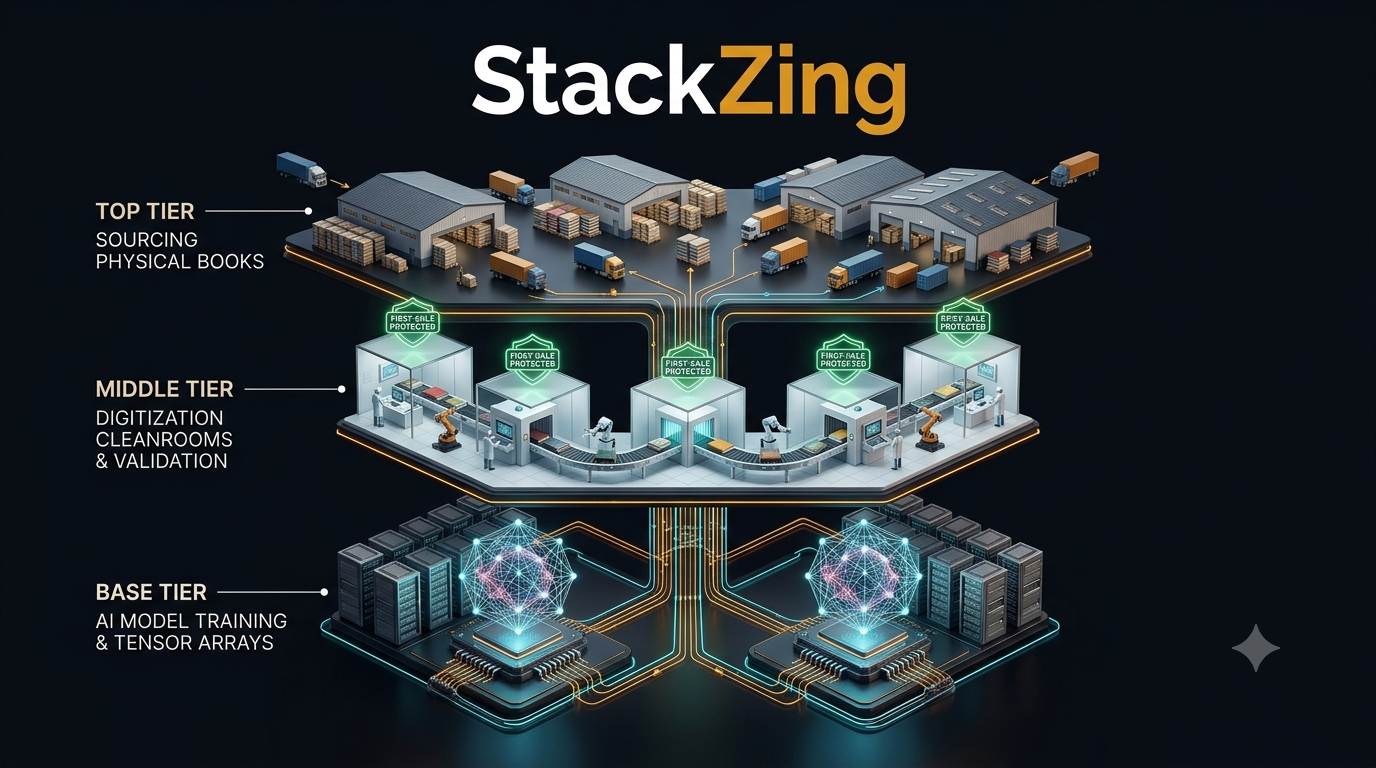
As foundational AI laboratories build out multi-billion-dollar training pipelines, dataset acquisition strategies have fragmented into three distinct structural approaches:
5. The Author Asymmetry: Ethical Tension vs. Legal Reality
While the judicial interpretation under Judge Alsup provides a clear legal shield for AI developers, it accentuates an unprecedented economic asymmetry between enterprise technology conglomerates and individual creators:
6. Strategic Implications for Enterprise Tech Leaders & Policymakers
The institutional endorsement of destructive physical scanning sets three strategic vectors that will define the AI ecosystem over the next decade:
- Physical Ingestion Infrastructure as a Corporate Asset: Advanced AI enterprises will likely institutionalize physical book and document procurement pipelines as permanent operational divisions to insulate future training runs from digital copyright litigation.
- Regulatory Pressures for Statutory AI Royalties: In response to the First-Sale Doctrine loophole, legislative bodies across the European Union, the United Kingdom, and the United States are facing calls to enact statutory AI remuneration schemes—similar to historical broadcast music licensing or blank-media levies.
- The Premium on Human-Curated Data: The extraordinary measures undertaken in Project Panama demonstrate that authentic human reasoning remains the ultimate bottleneck in artificial intelligence. While compute expands exponentially, verified human thought remains finite, scarce, and indispensable.
The Strategic Verdict
Project Panama reveals that the race to build frontier artificial intelligence is not merely an algorithmic competition, but an industrial-scale campaign to extract, digitize, and tokenize human knowledge. While Judge Alsup’s ruling provides clear legal protection for physical destructive scanning under current fair-use doctrine, it leaves unanswered the broader economic challenge of how society will sustainably fund and protect human authors whose lifetime of creative output underpins the trillion-dollar artificial intelligence economy.
Master Enterprise Tech, AI Architecture & Legal Frameworks
Join thousands of technology executives, legal counsels, and portfolio managers who rely on the StackZing Morning Intelligence Brief. Daily 5-minute data-driven breakdowns delivered straight to your inbox. Zero spam.