

The Warsh Shock: What the Fed’s Hawkish Turn and the End of "Forward Guidance" Mean for Your Portfolio
Inside Fed Chair Kevin Warsh’s Jackson Hole keynote, the repricing of the global risk-free rate, and the tactical asset allocation playbook across equities, fixed income, and sector rotations.

Global capital markets entered the annual Jackson Hole Economic Symposium expecting confirmation of a prolonged interest rate-easing cycle. They exited facing a fundamental regime shift. Marking his 100th day as Federal Reserve Chair, Kevin Warsh delivered a landmark keynote titled "In Our Time," signaling that stubborn inflation prints (CPI at 3.4%, PCE at 3.7%) mean monetary policy is not yet sufficiently restrictive. By declaring that explicit forward guidance has "overstayed its welcome," Warsh dismantled a 15-year central banking orthodoxy, putting potential rate hikes back on the table and triggering an immediate repricing across global discount rates, high-beta equity multiples, bond duration curves, and emerging market capital flows.
1. The Death of Forward Guidance: Why Volatility Just Reset
Since the aftermath of the 2008 Global Financial Crisis, through the tenures of Ben Bernanke, Janet Yellen, and Jerome Powell, the Federal Reserve relied on Forward Guidance as an active policy instrument. Central bankers telegraphed exact rate trajectories months in advance to suppress market volatility, compress term premiums, and guide corporate borrowing conditions.
Chair Warsh dismantled this practice in a single stroke, stating:
"Forward guidance as a regular practice was adopted during the Global Financial Crisis... But, as with other legacies of crises past, I believe that the practice has overstayed its welcome. If markets rely materially on the Fed's guidance and the Fed relies on market prices, we are all more likely to be blinded to new developments and commit errors in policymaking."
By removing forward guidance, the Federal Reserve has reintroduced a macro volatility risk premium. Investors can no longer price assets based on central bank promises; they must price assets based on raw, high-frequency inflation prints and underlying corporate cash flows.
2. The Valuation Math: Discount Rates and Multiple Compression
The fundamental transmission mechanism of monetary policy into equity portfolios is governed by the Discounted Cash Flow (DCF) framework. The theoretical enterprise value of an asset is the sum of its expected future cash flows ($CF_t$), discounted back to the present value at the Weighted Average Cost of Capital ($WACC$):
When Chair Warsh signals that interest rates will remain elevated or head higher, two simultaneous shocks occur:
- The Denominator Shock: As the risk-free rate ($R_f$) rises, the discount rate increases exponentially for cash flows expected far in the future. High-multiple, speculative growth stocks experience severe multiple compression because their terminal value makes up the vast majority of their present valuation.
- The Cost of Capital Shock: For debt-leveraged mid-cap companies, higher borrowing costs directly reduce net profit margins ($CF_t$), creating a double-drag of lower earnings and lower valuation multiples.

3. Sectoral Breakdown: Winners, Losers, and Hedging Corridors
The transmission of a hawkish Federal Reserve does not impact all sectors equally. In an environment marked by a surging U.S. Dollar Index (DXY) and elevated borrowing rates, capital rotates along clear structural corridors:
The Discretionary Budget Headwind: Conversely, enterprise clients in the U.S. facing 4%+ interest rates scrutinize uncommitted cloud migrations and software implementations. Focus on cash-rich Tier-1 IT leaders with mission-critical cost-takeout and Agentic AI deployment mandates.
4. Liquidity Dynamics: FII Repatriation vs. Structural Domestic SIPs
Historically, a hawkish Federal Reserve triggered severe "Taper Tantrums" across emerging markets. In 2026, the institutional structure of equity markets has evolved dramatically:
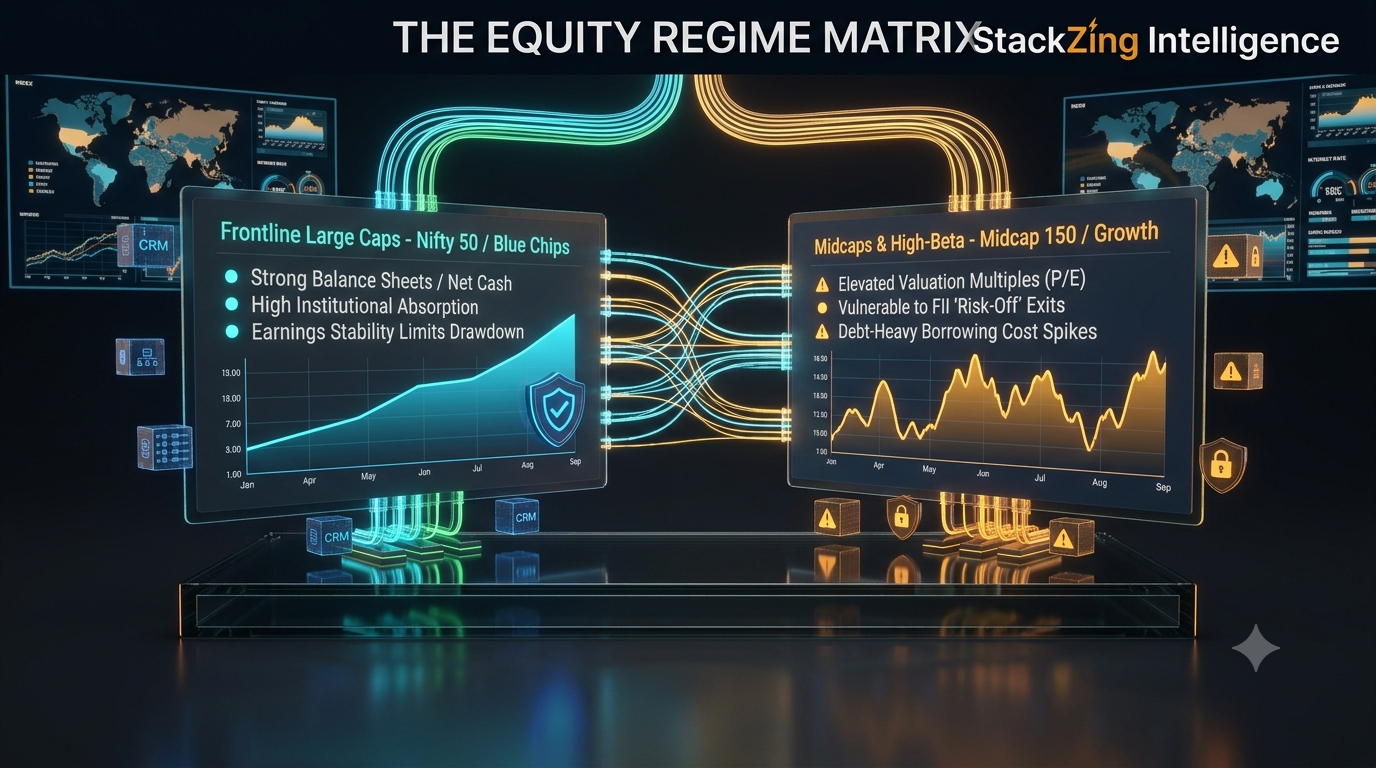
The tug-of-war between foreign and domestic liquidity functions as follows:
- Foreign Institutional Investors (FIIs): As U.S. short-term risk-free rates remain elevated near 4%, global macro funds reallocate capital back into sovereign dollar instruments, creating tactical secondary-market selling pressure.
- Domestic Institutional Investors (DIIs): Domestic monthly SIP inflows (averaging over $3 billion per month) provide persistent, counter-cyclical liquidity. Domestic retail and retirement pools absorb foreign selling, putting a structural floor under broad market corrections and turning pullbacks into accumulation opportunities.
Master Global Macro Policy, Silicon & Market Architecture
Join 5,000+ technology leaders, portfolio managers, and enterprise executives receiving our free 5-minute morning intelligence brief. Zero fluff. Pure signal.
Subscribe Free at thestackzing.com →5. The 4-Step Strategic Playbook for Portfolio Rebalancing
Navigating the Warsh monetary regime requires disciplined balance-sheet allocation rather than speculative momentum chasing. Implement the following 4-step portfolio framework:
The Strategic Verdict: Discipline Beats Speculation
The conclusion of Kevin Warsh’s Jackson Hole address is clear: the era of zero-cost capital and central bank forward guidance has ended. The market has returned to a regime governed by fundamental discipline, cash flow visibility, and balance-sheet resilience.
For long-term investors, market volatility driven by hawkish central bank rhetoric is not a crisis—it is an asset-rebalancing window. By anchoring portfolios in high-quality market leaders, managing debt duration, and systematically deploying capital into pullbacks, disciplined allocators will continue to compound wealth through the cycle.
Never Miss a Macroeconomic Regime Shift
Join thousands of portfolio managers, enterprise architects, and technology leaders who read the StackZing Intelligence Morning Brief. Daily 5-minute data-driven breakdowns delivered straight to your inbox.